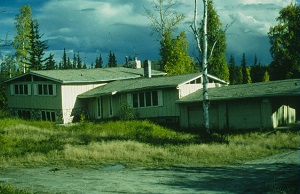
Structurally damaged house resulting from permafrost degradation.
Alaska's unique landscape, characterized by permafrost, remote infrastructure, and a rich glacial history, presents distinctive challenges for development and public safety. The state's limited road system is crucial for its GDP, and further development can enhance public access to essential resources, including healthcare and recreational opportunities. The Hydrology & Surficial Geology Section enhances community well-being and infrastructure by providing valuable insights into the state's engineering potential and supporting hazard mitigation for existing infrastructure.
The section's work provides valuable information for land-use planning and decision-making, including the location of construction materials and areas with potential for hydroelectric power. It also helps scientists and other stakeholders with critical investigations, often related to geologic hazards such as landslides, faulting, permafrost, flooding, and erosion.
The Section comprises four major programs: Hydrology, Surficial Geologic Mapping, Renewable Hydropower, and Lidar (Light Detection and Ranging) Programs. Section staff are committed to:
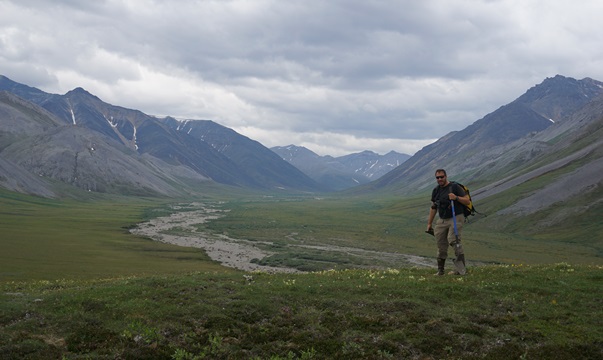
Nick Crawford during 2024 fieldwork in Anaktuvuk Pass
Trent D. Hubbard
Hydrology & Surficial Geology Section Chief
Phone: 907-451-5009
Email: trent.hubbard@alaska.gov